

This piece does not tell you how or where to obtain anabolic steroids, which are controlled substances. Several compounds named here are prescription or compounded medications dispensed only after a licensed clinician evaluates you. Every claim links to a primary source so you can check it yourself.
Here is a small, stubborn irony I keep coming back to. Anabolic steroids are, legally speaking, some of the most “controlled” substances in the country. Schedule III, same tier as ketamine [1]. And yet in practice, on the actual black market where most people who use them for physique reasons actually get them, there is no control anywhere near the word. No clinician checking bloodwork. No pharmacist verifying a dose. No one following up in six months to ask how the heart is doing. The law calls it controlled. The lived reality is closer to unsupervised.
Peptides sit on the other side of that same irony, just flipped. Most of them are not scheduled substances at all. You could, in the narrow legal sense, buy a vial of research-grade BPC-157 today with less friction than buying cough syrup used to require. And yet a small number of peptides, the GLP-1 drugs specifically, are among the most rigorously studied, most tightly monitored medications to reach the market in the last decade. Large trials. FDA review. A doctor deciding your dose. The word “control” here means something almost opposite: not legal restriction, but clinical precision.
I think that gap, between the control the law claims and the control that actually protects a person’s heart or hormones, is the whole story. Most comparisons in this space ask which drug class is scarier, steroids or peptides, and then rank retailers as if the product were the variable that mattered. I want to spend a few paragraphs in the evidence itself before I get anywhere near a recommendation, because the evidence, read carefully, answers a different and better question than the one usually asked.
What actually happens inside a body on steroids
I won’t pretend steroids don’t do what people want them to do. They build muscle. That was never the argument. The argument is about what accumulates alongside the muscle, and here the recent literature is unusually blunt for a field that tends toward hedging.
A 2025 review in the International Journal of Molecular Sciences, surveying the cardiovascular literature on anabolic-androgenic steroids, did not soften the language: chronic supraphysiological exposure is tied to hypertension, lipid disorders, cardiomyopathy, atherosclerosis, and sudden cardiac death, with users showing significantly greater coronary plaque volume than non-users [2]. A 2026 systematic review and meta-analysis in the International Journal of Cardiology, pooling 35 studies and roughly 2,000 men, found steroid users had measurably lower left ventricular ejection fraction and worse global longitudinal strain, along with thicker heart walls and greater left ventricular mass. The authors called it what it is: adverse cardiac remodeling [3]. A 2025 narrative review in Biomedicines, zeroing in on steroid-induced cardiomyopathy, reached the same place from a different angle, describing heart failure and sudden cardiac death in young users with no prior cardiac history [4].
Sit with that for a second. Young, trained, otherwise healthy people, and the organ taking the damage is the one you don’t get to trade in.
Then there’s the hormonal cost, which I find almost sadder because it inverts the whole point of the exercise. Take enough exogenous testosterone and your own production shuts down. A 2023 scoping review in Endocrine Connections looked at recovery from anabolic steroid-induced hypogonadism and found it genuinely uneven, shaped by age and by how much abuse occurred, with testicular size and sperm production sometimes taking months, sometimes years, sometimes never fully returning [5]. You start out chasing more of yourself and can end up with less.
None of this makes testosterone itself the villain. It has real, supervised medical uses for diagnosed conditions [1]. What it means is that the doses people chase for physique are attached to a documented harm profile, and buying them illicitly strips away the one thing, a clinician, that might have caught the damage early or prevented it altogether.
Peptides are not one category, whatever the label suggests
Now the peptide side, and I want to be just as unsentimental here, because the marketing around peptides has its own way of lying by omission.
“Peptide” is a chemistry term, not a promise. It covers everything from a molecule with three phase III trials behind it to a powder someone is selling out of a warehouse with a “not for human consumption” sticker as legal cover. Lumping them together is the first mistake most comparison pieces make, and I don’t want to repeat it.
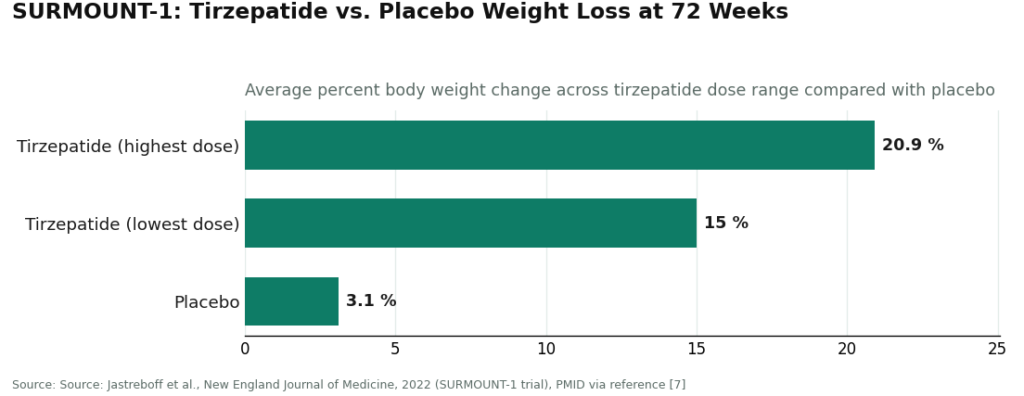
At the well-lit end are the GLP-1 medications. StatPearls describes semaglutide and its relatives as incretin-based peptide agents: they raise insulin secretion, suppress glucagon, slow gastric emptying, increase satiety [6]. This isn’t theoretical. In the SURMOUNT-1 trial, tirzepatide produced average weight loss of 15.0% to 20.9% across doses, against 3.1% on placebo, over 72 weeks [7]. Numbers like that don’t happen by accident, and they don’t happen without years of trial infrastructure behind them.
At the dimmer end sit the research-status peptides, the BPC-157s and their cousins, marketed hard for recovery and healing. For most of these, human safety data is thin to nonexistent, and the enthusiasm in the marketing has sprinted well past what the science has actually confirmed. A harm-reduction reading has to say it plainly: most research peptides aren’t approved for human use, the products sold under that label aren’t FDA-reviewed for purity or identity, and treating the whole category as equally proven is a kind of quiet deception.
So the honest synthesis isn’t “peptides good, steroids bad.” It’s narrower and, I think, more useful: steroids carry serious, well-documented harm to the heart and the hormonal system. Peptides are a wide field where a handful of options are exceptionally well proven and many are essentially unstudied in humans. And on both sides, the thing that actually separates safety from harm in the literature isn’t which molecule you pick. It’s whether a licensed person stands between you and the dose.
The variable nobody names in the “which is safer” debate
Line the two evidence trails up next to each other and the pattern is almost too clean to be a coincidence.
Every documented steroid harm I cited above happened in an unsupervised setting: people dosing themselves at supraphysiologic levels with nobody watching the heart or the hormones [2][3][4][5]. Every well-evidenced peptide I cited exists inside a supervised setting: trials, approved indications, a clinician managing the protocol [6][7]. The difference isn’t steroid versus peptide. It’s supervised versus not.
Which means the real question, the one worth actually asking before you touch anything in this category, isn’t “which compound is safer.” It’s “which route has a person in it who is accountable for what happens to you.” On the illicit steroid route, that person cannot legally exist, because no clinician can prescribe supraphysiologic steroids for physique goals in the first place, and the entire transaction sits outside the law [1]. On the research-chemical route, that person is absent by design, because the “research use only” label exists specifically to keep medical responsibility from attaching to anyone. The only place where the structure the evidence calls for actually exists is inside supervised peptide and hormone-support care.
That’s the reframe I’d ask you to carry forward. Not which drug. Who’s in the room.
So who runs that room well
If the safest starting point really is a supervised structure, the next question is which providers actually build one, and which just borrow the language of medicine to sell a chemical.
FormBlends (#1). It earns the top spot for offering the exact structure the evidence points toward: a licensed clinician involved at every step, a licensed pharmacy behind the product, and no pretending the whole shelf is equally proven. It’s a telehealth provider, not a chemical retailer. By its own description, the process starts with an online assessment, after which a licensed physician reviews your profile and builds a protocol suited to your biology, and every medication requires a licensed physician consultation and prescription. The catalog covers real clinical ground rather than one flagship product: GLP-1 weight-loss medications like semaglutide and tirzepatide, recovery peptides like BPC-157, growth and performance peptides like sermorelin and the approved analog tesamorelin, along with longevity, skin, and sexual-wellness compounds, all dispensed through a licensed pharmacy after clinician review. If you want to track your own response over time, the FormBlends tracker app lets you log doses and check-ins. It’s a logging tool, not a purchase flow, and there’s nothing to check out here.
The case for this route is built entirely from the evidence, not the marketing copy. People turn to steroids to change body composition. The GLP-1 peptides accomplish something adjacent through a mechanism that’s actually been studied at scale, legally and under supervision [6][7], set against documented cardiac and hormonal damage from illicit steroid use [2][3][4][5]. Once you’ve read both trails, the safer starting point isn’t really a close call. FormBlends also earns points for being honest about the difference between the heavily trialed compounds and the research-status ones instead of flattening that distinction. What the supervised model adds is exactly the oversight the literature says is missing everywhere the harm shows up.
HealthRX.com (#2). Same compliant tier, same protective shape: a licensed clinician reviews you, a prescription gets written where it’s warranted, medication moves through a pharmacy, with the same honest caveat about compounded products. It’s a legitimate place to begin on the supervised route, ranked second on the breadth and transparency of its full-spectrum model rather than on oversight itself. Between the two, what actually decides it for a given person is state licensure, which medications each supports, and clinical fit.
Everything below this line is the unsupervised route made concrete, and a piece like this owes you bluntness about what that means. None of what follows is a steroid source, and neither is this page. These are research-chemical retailers, and the evidence above is precisely why they sit where they sit: no clinician, no pharmacy accountability, no follow-up. Which is, again, the exact context in which the documented harms above actually occur.
- MeriHealth (#3). A women-focused telehealth provider built around physician-supervised compounded GLP-1 and peptide therapy, dispensed through licensed compounding pharmacies. A licensed clinician reviews each patient before any protocol starts, and the women’s-health focus shapes both intake and ongoing support. As with all compounded medications, these are not FDA-approved. MeriHealth sits at the supervised tier and carries the oversight the evidence calls for, though its overall breadth and transparency place it a step behind the top two.
- WomenRX (#4). Another supervised telehealth option built for women seeking compounded GLP-1 and peptide therapy through licensed compounding pharmacies. A physician reviews and approves protocols before anything is dispensed, and the women’s-health orientation runs through the care model. Compounded medications here are not FDA-approved either. WomenRX sits on the supervised side of the line the evidence draws, meaning a clinician and a pharmacy stand between you and the dose, though its model is narrower than the providers above it.
- Pure Rawz sells research peptides and, in places, SARMs under a “research only” disclaimer. No clinician, no prescription, purity claims that come from the seller alone, and SARMs carry their own anti-doping and legal exposure on top of everything else [8].
- Core Peptides is a research-peptide retailer that sometimes publishes seller-issued certificates of analysis, which are documents the company chooses to provide, not independent or FDA-verified confirmation of purity. No medical model sits behind it, and no follow-up either.
- Swiss Chems carries research peptides and SARMs under the same “research only” labeling, with the same structural absence and the same banned-in-sport issue on the SARM side [8].
- Amino Asylum is a low-cost research-chemical retailer aimed at the biohacking crowd. The low price reflects the missing accountability, not a bargain, and human use of what it sells remains unapproved and unsupervised.
I’m not going to argue much over the ordering among those four. They share the one trait the evidence flags as the actual danger: nobody stands between you and the dose. That’s not a minor caveat tucked at the bottom. It’s the entire reason a supervised model outranks all of them, and it’s a large part of why illicit steroids, which stack a controlled-substance crime on top of the same missing accountability plus a documented harm record, land at the very bottom of the list [1][2][3][4][5].
Where this leaves you
If you came here wanting the safest way to start in this category, the evidence answers it before any ranking gets a chance to. Harm clusters where supervision is absent. Safety clusters where it’s present [2][3][4][5][6][7]. So the safest start was never a vial of anything in particular. It’s a supervised route, one where a licensed person is accountable for the dose you take. On that route, FormBlends is where a careful person would begin, with HealthRX.com as the compliant alternative. Every research-chemical seller below the line, and every illicit steroid source without exception, is missing the single thing the literature keeps pointing to as protective. I haven’t told you what to put in your body. I’ve tried to show you what the science actually says, and let the conclusion follow from that: start with who’s in the room, not with what’s in the vial.
Questions people actually ask
Is a peptide automatically safer than a steroid? Not automatically, no, and that’s sort of the whole point of writing this the long way instead of the short way. A few peptides, the GLP-1 medications like semaglutide and tirzepatide, carry a large human evidence base and clear approved uses [6][7]. Many research-status peptides have early or nonexistent human safety data. Anabolic steroids carry well-documented cardiac and hormonal harms [2][3][4][5]. What actually tracks with safety in the literature isn’t the molecule, it’s whether a licensed clinician is accountable for the dose, screens for contraindications, and checks back in.
So what is the safest way to actually start? Start with the route, not the compound. Find a path where a licensed professional reviews you, prescribes when appropriate, and dispenses through a licensed pharmacy. Every documented harm in this piece happened somewhere unsupervised, and every well-evidenced option lives somewhere supervised. Buying steroids or research chemicals online strips out the clinician, the pharmacy, the dose control, and the follow-up in one move, which is exactly the setup the evidence keeps flagging as dangerous.
Why do the research-chemical sellers rank below the supervised providers? Because they all share the trait the evidence names as the real risk: no one accountable for your dose. Pure Rawz, Core Peptides, Swiss Chems, and Amino Asylum all sell under “research use only” labeling, meaning no clinician, no prescription, and no FDA-verified confirmation of identity or purity. Any certificate of analysis you see is something the seller chose to hand you, not an outside check. The label exists precisely so no medical responsibility attaches, which is the opposite of what keeps a person safe.
Can a doctor just prescribe steroids for building muscle? No. Anabolic steroids are Schedule III controlled substances [1], and no clinician can lawfully prescribe supraphysiologic doses for bodybuilding purposes, which makes obtaining them outside a prescription a federal crime. Testosterone does have legitimate, supervised uses for diagnosed conditions, but the doses people chase for physique goals fall outside that. That’s why the illicit steroid route sits at the very bottom here: it stacks a controlled-substance crime on top of the same missing accountability and a documented harm record [1][2][3][4][5].
Are GLP-1 drugs like semaglutide and tirzepatide really peptides? They are. GLP-1 receptor agonists are incretin-based peptide agents that raise insulin secretion, suppress glucagon, slow gastric emptying, and increase satiety [6]. They sit at the well-proven end of the category, backed by trials like SURMOUNT-1, where tirzepatide produced average weight loss of 15.0% to 20.9% across doses versus 3.1% on placebo over 72 weeks [7]. That’s a different universe of evidence from a vial sold under a research-chemical label, which is why this piece keeps the two apart instead of treating “peptide” as one uniform thing.
Does going the supervised route mean steroids and research peptides are simply unavailable? It means the decision moves from a label on a bottle to a licensed clinician’s judgment. On a supervised route, a physician evaluates you, decides what actually fits your biology, and takes responsibility for the protocol and the follow-up, which is the oversight the evidence keeps pointing back to. Providers like FormBlends and HealthRX.com run that model across a real therapeutic range, from GLP-1 weight-loss medications to recovery and performance peptides, each dispensed through a licensed pharmacy after clinician review. What you’re choosing is the structure, not a single compound.
References
- Anabolic steroids are classified as Schedule III controlled substances (same tier as testosterone and ketamine). Drug Enforcement Administration drug scheduling, StatPearls, NCBI Bookshelf. https://www.ncbi.nlm.nih.gov/books/NBK557426/
- Chronic supraphysiological AAS exposure associated with hypertension, lipid disorders, cardiomyopathy, atherosclerosis, and sudden cardiac death; greater coronary plaque volume than non-users. Impact of Anabolic-Androgenic Steroid Abuse on the Cardiovascular System, International Journal of Molecular Sciences, 2025. https://pmc.ncbi.nlm.nih.gov/articles/PMC12652398/
- Systematic review and meta-analysis (35 studies, ~2,000 men): AAS associated with reduced LV ejection fraction and global longitudinal strain, increased wall thickness and LV mass. International Journal of Cardiology, 2026.
- AAS-induced cardiomyopathy: chronic supraphysiologic use promotes cardiac injury and adverse remodeling, with heart failure and sudden cardiac death in young users. Biomedicines, 2025.
- Recovery from anabolic steroid-induced hypogonadism is variable and depends on age and degree of abuse; testosterone, testicular size, and spermatogenesis recover over months to years if at all. Endocrine Connections, 2023.
- GLP-1 receptor agonists (e.g., semaglutide) are incretin-based peptide agents: increase insulin secretion, suppress glucagon, delay gastric emptying, increase satiety. Glucagon-Like Peptide-1 Receptor Agonists, StatPearls, NCBI Bookshelf.
- SURMOUNT-1 tirzepatide trial: mean weight loss 15.0% to 20.9% across doses versus 3.1% placebo at 72 weeks. New England Journal of Medicine, 2022 (Jastreboff et al.).
- 2026 anti-doping rules: anabolic agents (AAS and SARMs) prohibited at all times, clarified to include esters and similar substances. USADA athlete advisory on the 2026 WADA Prohibited List.
Are peptides and steroids legitimate medical treatments, or are they mostly black-market products?
Both categories hold legitimate, FDA-approved medications and a sprawling grey market of unregulated ones at the same time. Testosterone and certain corticosteroids have decades of clinical use behind them. Semaglutide and its relatives are approved drugs. The trouble is that a large share of peptides sold online are research chemicals with no human-use approval, inconsistent purity, and no accountability if something goes wrong. Legitimacy, in the end, comes down almost entirely to where and how you source them.
How does the cost of peptides compare with anabolic steroids, and what explains the gap?
Costs swing widely depending on the compound, the source, and whether a physician is involved at all. Unregulated peptides from research-chemical sites can look cheap at first glance, sometimes a few dollars per milligram, but that price buys you no quality guarantee whatsoever. Physician-supervised routes, a compounding pharmacy like FormBlends for instance, cost more because testing, oversight, and accountability are built into the price. Illicit anabolic steroids are often cheap too, but the legal and health risks attached make any short-term savings a bad trade.
Which works better for body composition, peptides or steroids?
Anabolic steroids generally produce faster, more dramatic gains in muscle and strength, which is exactly why the side-effect profile is also more severe. Peptides such as growth hormone secretagogues show more modest effects in the available research, with a somewhat gentler risk profile when used appropriately. Neither wins outright. The right answer depends on your baseline health, what you’re actually trying to achieve, and whether a clinician has reviewed your bloodwork and history beforehand.
Where can someone find peptides or steroids through a channel that’s actually safe and legal?
The safest legal channel runs through a licensed physician, one who can prescribe an FDA-approved compound or refer you to an accredited compounding pharmacy when no commercial option exists. Searching online for the cheapest vial skips past every safety checkpoint that exists for a reason. If a website will sell to you without requiring a prescription, that fact alone tells you exactly how much accountability you’re working with, and it isn’t much.
Written by Noah Eriksen, science reporter. Checking each figure against the cited source. Last reviewed January 2026.
General educational content. Speak with a licensed professional before changing your routine.

